The Welpr Rating is determined by a scoring formula. The formula takes into account the products safety, user satisfaction, and eco-ethical standing. Click here to learn more.


Best Non-Toxic Dusting Spray in 2025
Updated:
Aug 28, 2025

Written by Camille May
Cofounder & Product Curator
+ 1 more

Medically reviewed by Olushola Awoyemi
PhD Environmental Toxicology
As an Amazon Associate, we earn from qualifying purchases. Our use of affiliate links does not influence how we rate products. Learn more about our affiliate policy here.
Welpr Approved cleaning products are always free from:
- Harsh disinfectants and irritants: bleach, ammonia, sulfates, and quats
- Endocrine disruptors and preservatives: phthalates, parabens, BHA/BHT, triclosan
- Unnecessary additives: optical brighteners, artificial dyes, and synthetic fragrance (unless certified safe)
- Undisclosed or hidden ingredients
Not all products in this category are Welpr Approved, but they’re safer than most. The ones that meet our full standard will have the Welpr Approved tag. View our full standards here.

Find Non-Toxic Dusting Spray
No items found.
Microfiber Duster for Cleaning, Unscented - Tukuos

Welpr Rating


4.85
/5
Certifications
Third-party certifications are key indicators of a product's safety, ethics, and environmental impact. Click the icon to verify the certification.

Highlights
Highlights aren't always verifiable, so you're trusting the brand when they say "lead free", etc. If the highlight icon is "clickable", it means we've verified the highlight.


User Satisfaction
User satisfaction is calculated using online reviews and a Bayesian average across all cleaning products on Welpr.

Est. Price
$7.99


Product Details

- Suitable for wet or dry use, providing flexibility in cleaning different surfaces.
- Made of soft microfiber, ensuring gentle and effective dust removal without toxic substances.
- Extendable pole allows for cleaning those hard-to-reach corners and areas with ease.
- Comes with 2 replaceable microfiber heads, making it convenient to switch when one becomes dirty.
- Ideal for dusting various areas such as cars, offices, windows, and household appliances.
Pros & Cons
Pros
- Reusable and washable microfiber cloths are eco-friendly.
- Telescope handle makes it easy to reach high places without a ladder.
- Comfortable and practical design simplifies cleaning tasks.
- Includes two replaceable microfiber heads, adding value and sustainability.
Cons
- Some users find the handle parts could be more robust for frequent use.
- A few users noted difficulty in fitting the duster in low-clearance spaces.
Ingredients
Ingredients can vary by product variation and may change at any time by the manufacturer. For the most complete and up-to-date list of ingredients, refer to the product packaging.
To analyze individual ingredients, use this EWG tool.
Ingredients: Rubber / Stainless Steel Handle, Microfiber Head
Genuine Ostrich Feather Duster, Unscented - Ddzmz

Welpr Rating
4.85
/5
Certifications
Third-party certifications are key indicators of a product's safety, ethics, and environmental impact. Click the icon to verify the certification.
Highlights
Highlights aren't always verifiable, so you're trusting the brand when they say "lead free", etc. If the highlight icon is "clickable", it means we've verified the highlight.
User Satisfaction
User satisfaction is calculated using online reviews and a Bayesian average across all cleaning products on Welpr.
Est. Price
$16.98
Product Details
- Made with genuine ostrich feathers that do not generate static electricity, keeping metal, glass, and plastic surfaces dust-free for longer.
- Soft and gentle on delicate surfaces, making it ideal for dusting fragile items without causing scratches.
- Lightweight and easy to maneuver, perfect for cleaning intricate spaces and sensitive areas like computers and precision instruments.
- Reusable and easy to maintain by simply shaking off dust after each use without the need for frequent washing.
- Suitable for various environments including homes, offices, and cars, particularly effective for cleaning pendant lamps, antiques, and decorative ornaments.
Pros & Cons
Pros
- Highly effective at picking up dust without spreading it into the air.
- Lightweight and easy to handle, making it great for daily use.
- Gentle enough for delicate items like paintings or collectibles.
Cons
- Some users mention it may not have as many feathers as expected, affecting dusting efficiency.
- Feathers may occasionally fall out, so longevity could be a concern for heavy users.
Ingredients
Ingredients can vary by product variation and may change at any time by the manufacturer. For the most complete and up-to-date list of ingredients, refer to the product packaging.
To analyze individual ingredients, use this EWG tool.
Ingredients: Wood Handle, Ostrich Feathers
All Purpose Wood Spray Cleaner - Aunt Fannie's

Welpr Rating
4.8
/5
Certifications
Third-party certifications are key indicators of a product's safety, ethics, and environmental impact. Click the icon to verify the certification.

Highlights
Highlights aren't always verifiable, so you're trusting the brand when they say "lead free", etc. If the highlight icon is "clickable", it means we've verified the highlight.

User Satisfaction
User satisfaction is calculated using online reviews and a Bayesian average across all cleaning products on Welpr.

Est. Price
$11.99
Product Details
- Breaks down dirt, food, grease, and grime without harsh chemicals.
- No-wax formula leaves no residue and requires no rinsing.
- Safe for use around kids and pets; dermatologist tested and hypoallergenic.
- EWG A-rated for safety, cruelty-free, vegan, and environmentally friendly.
- Simply spray on wood surfaces and wipe to dust and shine with ease.
Pros & Cons
Pros
- Free from harsh chemicals, perfect for health-conscious users.
- Delicious, mild scent that refreshes your home naturally.
- Leaves wood surfaces clean and shiny without residue.
- Safe for use around pets and children.
- Effective cleaner for various wood surfaces, from tables to cabinets.
Cons
- Some users found the nozzle challenging, requiring multiple squeezes.
- May strip oils from certain unfinished woods, suitable for sealed surfaces only.
Ingredients
Ingredients: Water, Surfactant (Caprylyl/Myristyl Glucoside), Triethyl Citrate, Litsea Cubeba (May Chang) Fruit Oil, Mentha Piperita (Peppermint) Oil, Citrus Limon (Lemon) Peel Oil, Citrus Aurantium Dulcis (Orange) Peel Oil, Mentha Viridis (Spearmint) Leaf Oil, Sodium Citrate, Citric Acid, Sodium Benzoate, Potassium Sorbate
Wood Cleaner and Conditioner - Mighty Mint

Welpr Rating
4.75
/5
Certifications
Third-party certifications are key indicators of a product's safety, ethics, and environmental impact. Click the icon to verify the certification.
Highlights
Highlights aren't always verifiable, so you're trusting the brand when they say "lead free", etc. If the highlight icon is "clickable", it means we've verified the highlight.
User Satisfaction
User satisfaction is calculated using online reviews and a Bayesian average across all cleaning products on Welpr.

Est. Price
$14.99
Product Details
- Cleans and conditions sealed wood surfaces without leaving toxic residue.
- Made from 100% plant-based ingredients including peppermint, soybeans, and vegetable oils.
- Free from petroleum-based ingredients like sodium lauryl sulfate.
- Also polishes non-wood surfaces like countertops, tile, and laminate.
- Safe to use around family and pets when used as directed.
Pros & Cons
Pros
- Cleans wood surfaces effectively without harsh scrubbing or damage to the finish.
Cons
Ingredients
Ingredients: Water, Glycerin, Polyglyceryl Oleate, Soap (From Plant Based Bean Oils), Peppermint Oil
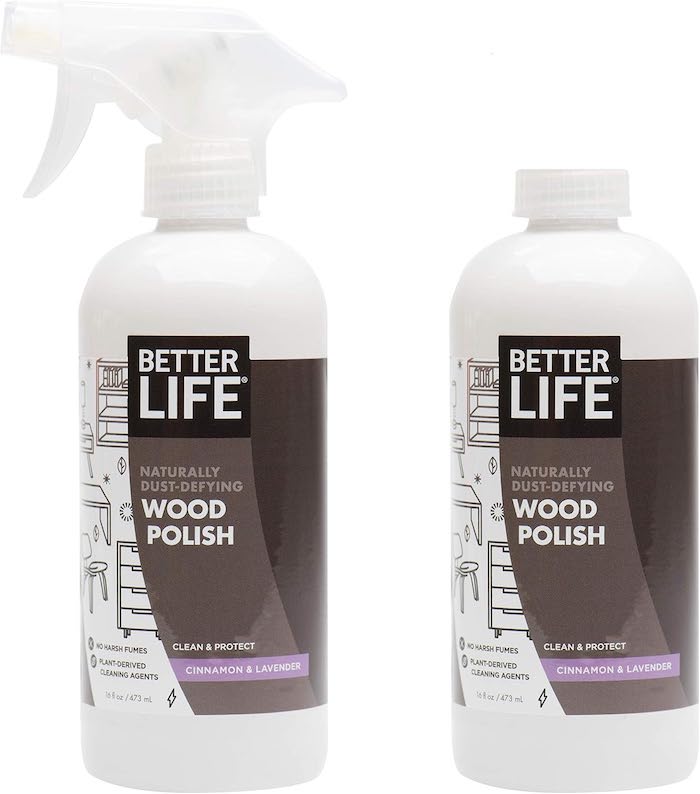
Wood Cleaner & Dusting Spray - Better Life
Welpr Rating
4.65
/5
Certifications
Third-party certifications are key indicators of a product's safety, ethics, and environmental impact. Click the icon to verify the certification.
Highlights
Highlights aren't always verifiable, so you're trusting the brand when they say "lead free", etc. If the highlight icon is "clickable", it means we've verified the highlight.
User Satisfaction
User satisfaction is calculated using online reviews and a Bayesian average across all cleaning products on Welpr.
Est. Price
$12.99
Product Details
- Freshen up your home with a sweet cinnamon lavender scent that lingers while wooden surfaces glow.
- Revitalize and restore antiques, rocking chairs, tables, and more with this furniture polish spray.
- Return cupboards, countertops, and flooring to a wax-like shine without the need to renovate.
- Eliminate dust and leave a gleaming finish by simply spraying and wiping with a microfiber cloth.
- Enjoy peace of mind with earth-friendly products free from harsh industrial ingredients.
Pros & Cons
Pros
- Leaves wood surfaces sleek and polished with no harsh chemicals.
- Non-toxic and safe for families and pets.
- Mild and pleasant lavender and cinnamon scent.
- Non-greasy and non-streaky finish.
- Effectively cleans and removes smudges without strong fumes.
Cons
- Some may find it requires multiple applications for a streak-free finish.
- A few users noted potential packaging issues during shipping.
Ingredients
Ingredients: Water, Naturally Derived Carnauba Wax Blend, Decyl Glucoside, Methylisothiazolinone, Methylchloroisothiazolinone, Cinnamomum Zeylanicum (Cinnamon) Leaf Oil, Lavandula Angustifolia (Lavender) Oil

Our Product Rating System
First, Camille (co-creator of Welpr) hand picks cleaner product options from a variety of sources.
Next, we collect information about each product's safety, consumer satisfaction, and eco-ethical standing.
Finally, we run all this information through an algorithm that calculates the Welpr Rating.
Welpr Rating:

5.0/5

Part 1: Product safety
We evaluate safety information from 3rd party organizations (e.g. EWG, Made Safe, etc.). Instead of relying solely on any one of these companies for safety information, we assess all of them.

Part 2: Consumer satisfaction
We scour the web for consumer ratings and reviews to verify products are not only cleaner options, but also effective. Products can either be Above Average, Average, or Below average for their respective category (e.g. cleaning products).

Part 3: Ethics & Environment
When you buy a product, you’re supporting that company with your dollars. We believe it’s important to support ethical companies, so we pool together certifications that verify a company's ethics and environmental impact.
Common Harmful Chemicals in Dusting Spray
Chemical Name
Why it’s harmful
1,1,1,2-Tetrafluoroethane
1,1,1,2-Tetrafluoroethane can cause frostbite through the evaporation of its liquid form. High concentrations of this chemical, when inhaled, may lead to central nervous system (CNS) depression and cardiac arrhythmias, as stated in the International Chemical Safety Cards (ICSC).
1,1-difluoroethane
1,1-difluoroethane is a flammable and toxic gas used as a refrigerant, aerosol propellant, and intermediate. Its toxicologic properties can cause effects such as light-headedness, irritation of the eyes, nose, and throat, pulmonary edema, palpitations, ventricular fibrillation, frostbite, and sudden death on exposure through inhalation or dermal contact. Additionally, it poses an explosion risk in confined spaces, with its vapor potentially igniting from heat, sparks, or flames. If leaked, 1,1-difluoroethane could cause fire, producing harmful fumes like hydrogen fluoride or phosgene. Shipping of 1,1-difluoroethane should be done carefully, avoiding passenger-carrying aircraft and railcars, and upon leakage, it should be isolated and not allowed to enter water sources or sewers.
Dimethyl Ether
Dimethyl ether, used at lethal concentrations, acts as a general anesthetic, according to animal studies. This chemical will cause frostbite in its liquid state. Additionally, the U.N. International Drug Control Programme has listed it as a potentially abusive volatile substance due to its capacity to cause narcosis in workers. Further, it caused slight inebriation at 50,000 ppm, partial incoordination at 82,000 ppm, and unconsciousness at 200,000 ppm (after 17 minutes) in human volunteers.
Polydimethylsiloxane
Permitted as an inert ingredient in non-food pesticide products, Polydimethylsiloxane is classified as an irritant. According to Scientific Polymer Products MSDS, it may form a siloxane polymer upon contact with skin, eyes, or lungs. This suggests the chemical can potentially cause irritation when users come into direct contact with it during use, emphasizing the importance of protective measures.

Authors
Camille May, Product Curator
Olushola M. Awoyemi, Medical Reviewer
