

Demeyere
Apollo Wok (12.6")
Est. Price$273.94
8.7
Performance
Ingredient Safety
Meets the Welpr Standard
Buy Now
on Amazon
Free From
Highlights
Made in EU
Dishwasher safe
30 year warranty
Flat bottom
12.5 in
Induction compatible
As an Amazon Associate, we earn from qualifying purchases. Affiliate links do not affect our ratings. Learn more.
We vetted woks against the Welpr Standard and here are our top picks.

Cofounder & Product Curator

Medical Reviewer, PhD
Here's what we look for:

On Welpr, terms like "non-toxic," "safer," "cleaner," "healthier," and "vetted" are editorial labels based on our own standard for product assessment. They are not guarantees, certifications, or medical claims. Learn more.
Demeyere
Meets the Welpr Standard
on Amazon
The 80/20 guide to going non-toxic the easy way.

Alva
Meets the Welpr Standard
on Amazon

Hestan
Meets the Welpr Standard
on Amazon

Demeyere
Meets the Welpr Standard
on Amazon

de Buyer
Meets the Welpr Standard
on Amazon
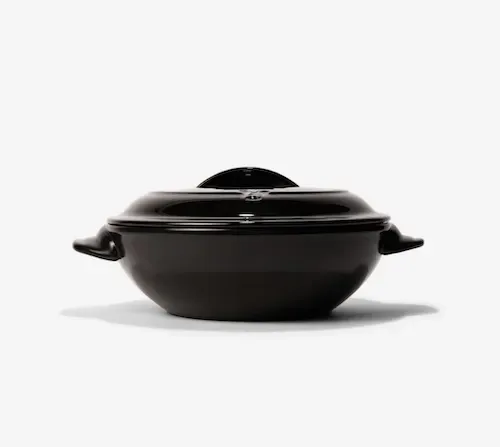
Xtrema
Meets the Welpr Standard
WELPRon Xtrema
Here's how to swap to non-toxic woks:
A wok is a high-heat cooking surface that comes in direct contact with your food, so the materials it's made from matter. Some woks use nonstick coatings or reactive metals that can release unwanted substances into food, especially at the high temperatures wok cooking requires. Welpr focuses on what the cooking surface is made of, whether any coatings are truly safe, and how the wok handles intense heat.
Look at your current wok and identify what the cooking surface is made from. Check the product packaging, any tags, or the manufacturer's website for material details. Welpr does not have a scanner for cookware, so you'll need to review this information yourself.
If you're not ready to replace your wok right away, a few small changes can help reduce what transfers into your food. This is especially useful if your wok has a nonstick coating that may be wearing down.
The best woks are made from simple, non-reactive materials with no synthetic coatings. Carbon steel and cast iron are classic choices — both develop a natural nonstick surface when properly seasoned and handle high heat exceptionally well. Stainless steel is another solid option.
Cofounder & Product Curator
Camille May is the co-creator of Welpr and a guide for clean living. After selling her last company in the health food space, she went non-toxic while working to heal an autoimmune condition....
Medical Reviewer, PhD
Olushola M. Awoyemi (aka Shola) is a board-certified toxicologist and a research scientist with a PhD in Environmental Toxicology. Shola's long-term ambition is to be recognized as a world-renowned expert in toxicology,...
